

Planning and Safely Installing Garage Lighting
Today, a garage is often much more than just a place to park a car. Many homeowners store bicycles, tires, tools, gardening equipment, or supplies there. Others also use the garage as a small workshop. That’s why garage lighting shouldn’t be an afterthought, but rather incorporated early in the planning process. After all, good lighting makes the garage safer, tidier, and more comfortable. Furthermore, well-thought-out electrical planning helps avoid the need for retrofits later on.
What are the key points about garage lighting in a nutshell?
- Why is good garage lighting more than just “turning on the light”? Good garage lighting enhances safety, comfort, and functionality because it makes parking, getting out of the car, finding items, and working significantly easier.
- What types of lighting does a garage need? A modern garage requires general lighting, task lighting, exterior lighting, and, depending on its use, additional wayfinding lighting.
- What should homeowners look for when it comes to LEDs, lumens, and Kelvin? For LED lighting in the garage, brightness in lumens, power consumption in watts, and an appropriate light color in Kelvin are key factors.
- How bright should a garage be? The appropriate brightness depends on whether the garage is used only for parking, as storage space, or also as a workshop.
- Is garage lighting with motion sensors or light switches better? A combination of motion sensors for short trips and light switches for longer tasks is usually the most practical.
- How should electrical connections, outlets, and future planning be coordinated? Lighting design, outlets, garage door openers, e-bike charging, and a potential wallbox should be planned together early on.
- What can DIYers do themselves when it comes to garage lighting? DIYers can plan the lighting needs, fixture locations, and plug-and-play lights, but permanent electrical installations should be handled by a professional contractor.
Why is good garage lighting more than just “turning on the light”?
Good garage lighting doesn’t start with the light fixture, but with how the space is used. When you come home in the evening, you want to park your car safely without scraping against the wall, the garage door, or a bicycle. Bright, even light also helps when getting out of the car, as it makes it easier to spot trip hazards, toolboxes, or stored items.
Lighting also helps keep things organized. In many garages, tires, bicycles, crates of drinks, garden tools, and other items are packed tightly together. When the garage is dark, every search takes longer. If the garage is designed to be brighter, the storage space around the house can be used more effectively because shelves, corners, and walkways remain visible.
Lighting also plays a role in the garage’s value. A garage with well-planned lighting, an electrical connection, outlets, and door lighting doesn’t look like a simple storage room, but rather like a purpose-built functional area of the house. That’s why lighting is just as much a part of modern garage planning as the door, floor, drainage, and fixtures.
What lighting zones does a garage need?
A garage rarely needs just a single light source. It’s better to divide the space into lighting zones. This ensures light is provided where it’s actually needed. That saves energy, avoids shadows, and makes the garage more pleasant for everyday use.
What’s important when it comes to general lighting on the ceiling?
General lighting ensures that the garage is bright overall. It helps with parking, getting out of the car, tidying up, and cleaning. In many cases, two or three LED strips on the ceiling are better than a single central light fixture. This is because a central light fixture is often obscured by the vehicle, creating shadows on the sides—exactly where doors open or shelves are located.
LED lights are standard today because they are efficient and can be specifically selected based on brightness, light color, and intended use. The Federal Environment Agency notes that LED lights dominate the market today and that product specifications include, among other things, brightness in lumens, power in watts, color rendering, and light color in kelvins.
Why is task lighting useful at a workbench or on a shelf?
Anyone who changes tires, repairs bicycles, or organizes tools in the garage needs additional task lighting. Ceiling lighting alone is often insufficient because your own body casts shadows on the work surface. That’s why garage workshop lighting should be positioned directly above the workbench, on the shelf, or above the work area.
It’s important that the light doesn’t cause glare. It should illuminate the area evenly and be positioned so that hands, tools, and small parts remain visible. For simple maintenance work on a car or bicycle, a fixed LED light is often sufficient. For precision work, an additional adjustable light can be useful.
What is the purpose of outdoor lighting in front of the garage door and side door?
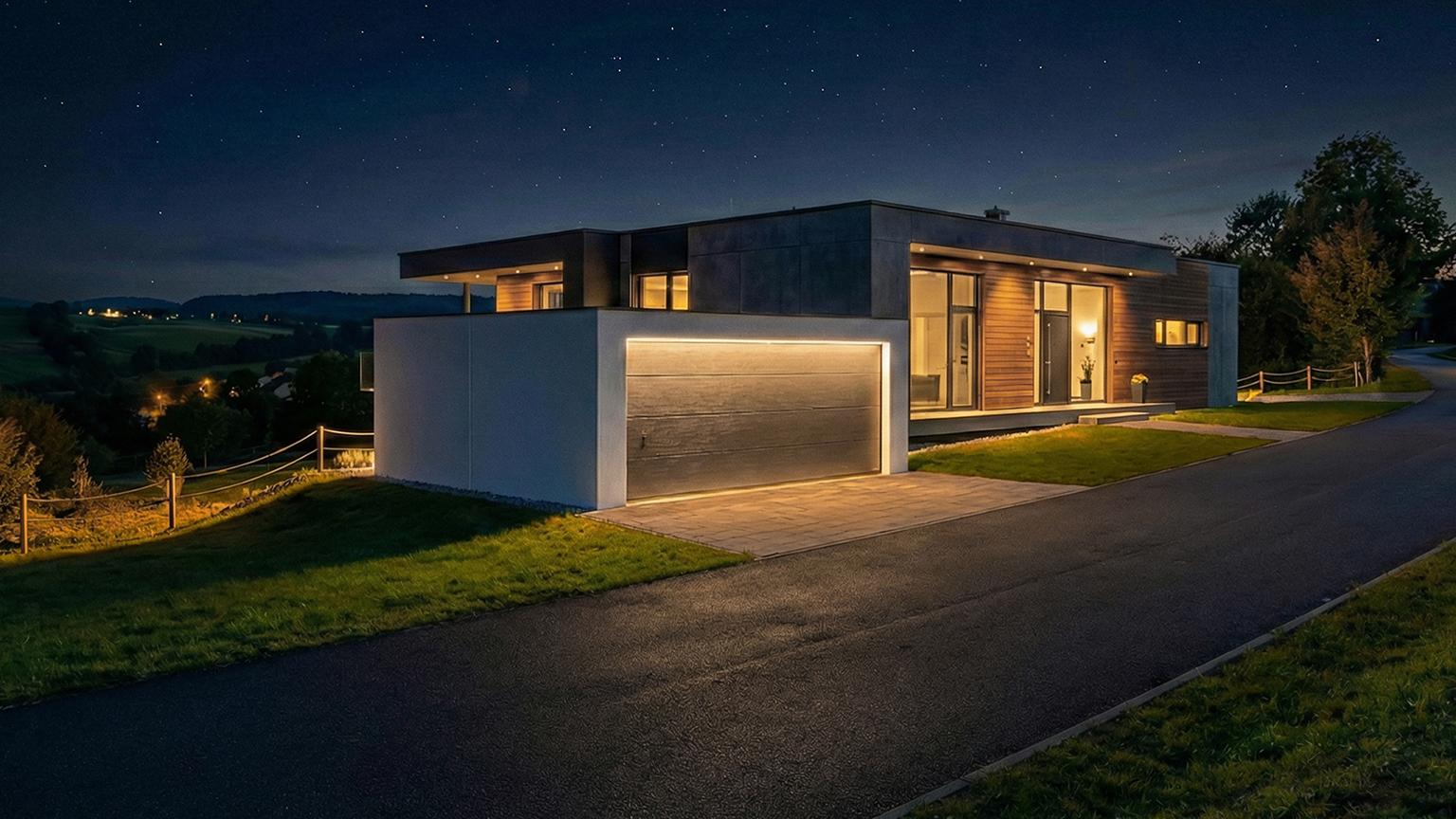
Outdoor lighting at the driveway helps when coming home, parking, and entering the garage. Lighting at the garage door, the side door, or along short paths is particularly practical. This allows you to spot obstacles, keys, steps, and the area around the garage door more quickly.
A motion sensor in the garage is often very useful here. The light turns on automatically when someone approaches. This ensures the driveway is better lit at night, while also preventing the light from staying on unnecessarily long. Alternatively, a twilight sensor can be helpful if you want the outdoor light to be active only after dark.
When is task lighting useful for walkways and storage areas?
Task lighting isn’t a must, but it’s very practical in everyday life. It’s helpful when you just want to quickly grab something—such as bicycles, trash cans, patio furniture, or shelves with supplies. Especially in larger garages or garages with an adjoining room, a small task light ensures that you don’t have to turn on all the lights every time.
What should homeowners look for when it comes to LEDs, lumens, and Kelvin?
When it comes to LED garage lighting, homeowners shouldn’t just focus on watts. In the past, brightness was often estimated based on watts. Today, lumens are more important. Lumens describe how bright a light is. Watts, on the other hand, describe how much electricity it consumes. The Consumer Advice Center explains that lumens are a key specification on light bulb packaging and that higher lumen values mean greater brightness.
Light color also plays a major role. It is specified in Kelvin. Warm white light creates a cozy atmosphere, but is often better suited for the living room than for the garage. Very cool, daylight-white light, on the other hand, can appear harsh. For many garages, neutral white light (4,000 Kelvin) is a good middle ground because it appears neutral, clear, and pleasant. The Consumer Advice Center classifies light colors based on the Kelvin rating and describes warm white and daylight white ranges.
It’s also worth considering color rendering. Anyone who paints, sorts, repairs, or needs to distinguish colors in the garage will benefit from lighting that renders colors naturally. Replaceable light sources are also a good idea if sustainability and maintainability are important. With an eye toward sustainability, the Consumer Advice Center recommends choosing lights with replaceable bulbs whenever possible.
How bright should a garage be?
The right level of brightness depends heavily on how the space is used. A garage that only houses a car requires less light than one with a workbench, shelving unit, and bike storage area. Therefore, you should first consider which tasks are regularly performed in the garage.
How bright should a garage be for parking only?
For parking only, even lighting is most important. The lighting should adequately illuminate the garage door, the sides of the vehicle, and walkways. At the same time, it must not cause glare, as glare near mirrors, the windshield, or the garage door can interfere with driving into the garage.
Multiple ceiling lights or LED strips mounted off to the side can help reduce shadows. This makes parking more convenient and allows small obstacles to be spotted more quickly.
How bright should a garage be for storage and everyday use?
If the garage serves as storage space, don’t forget about shelves and corners. Often, there isn’t enough light in those areas because a central light fixture is blocked by the car. That’s why it makes sense to plan lighting where items are searched for, carried, or stored.
If you store bicycles, tires, tools, and supplies, you should illuminate walkways and reach areas well. This makes it easier to keep the outdoor area organized and simplifies parking your bike.
How bright should a garage be for a workshop and DIY projects?
Workshops and DIY projects require significantly more light than simply parking a car. Although the Technical Rule ASR A3.4 applies to workplaces and not automatically to private garages, it clearly demonstrates that different visual tasks require different illuminance levels. The rule defines illuminance as the amount of light on a surface and measures it in lux. It also addresses glare, reflections, and area-specific lighting.
For private garages, this means that work areas should be lit more brightly than mere walkways. Good general lighting plus targeted task lighting is therefore usually better than a single very bright lamp for everything.
Is garage lighting with a motion sensor or a switch better?
A motion sensor is ideal for short distances. It works well for the driveway, the gate area, the side door, and a quick trip into the garage. Especially for garage door lighting, it ensures that the area is automatically illuminated as soon as you approach. You don’t have to search for a light switch, and the light turns off again after a certain amount of time. This saves electricity and increases convenience.
A traditional light switch in the garage remains important, however. If you’re working on your car for an extended period, using the workbench, or organizing shelves, you don’t want to have to keep the light on constantly just by moving around. That’s why a combination is often the best solution: automatic ambient lighting for quick access and manually controllable task lighting for longer activities. This creates safe lighting for DIY enthusiasts that’s both practical and suitable for everyday use.
Smart home solutions can also be useful. Using an app, a timer, or a lighting scene, you can set up driveway lighting, cleaning lighting, or a workshop mode, for example. This requires a suitable power connection in the garage as well as a professionally planned electrical installation. However, it’s important that the technology fits into your daily routine and isn’t unnecessarily complicated.
Anyone considering doing electrical work themselves should be aware that simply changing light bulbs or adjusting settings on existing devices is quite different from working on wiring, connections, or fuses. For anything related to the electrical installation, a professional contractor should be consulted.

How should power connections, outlets, and future planning be considered together?
Anyone planning lighting for their garage should also think about power connections and outlets at the same time. This is because lighting, the garage door opener, battery chargers, e-bikes, pressure washers, refrigerators, smart-home technology, and possibly a wallbox to be installed later are all part of the electrical planning.
Retrofitting outlets in the garage, in particular, often becomes more complicated later on if no extra outlets were planned during construction. That’s why it’s worth thinking early on about where power will be needed. It makes sense to have outlets at the workbench, near the garage door, on the side where the vehicle is parked, and, if necessary, in a storage area.
Safety is also part of the planning process. Residual current protection, circuit protection, and proper fusing are not minor details. A practical guide to electrical planning for garages lists, among other things, residual current circuit breakers (RCDs), automatic circuit breakers, and other components as important elements of electrical planning.
Anyone planning a new garage should therefore consider the electrical system and lighting early on. This not only makes the garage brighter but also better prepares it for future use.
What can DIYers do themselves when it comes to garage lighting?
Many homeowners want to install DIY lighting themselves—or at least prepare the setup. This is understandable, as planning and simple retrofits can often be handled easily on one’s own. Nevertheless, there are clear limits. Electricity can be dangerous, and mistakes in electrical installation can cause property damage, injuries, and liability issues. The garage plays a particularly important role in lighting design for single-family homes, as it, too, requires sufficient light for everyday use, safety, and comfort.
Which DIY tasks make sense?
The first sensible step is to assess your needs. Where is the car parked? Where should shelves be placed? Answering these questions allows you to mark light fixture positions and sketch out usage scenarios. Practical tips like these help you plan the garage more effectively and implement the design precisely later on.
Plug-and-play LED lights, battery-powered lights, or simple solar outdoor lights can also be a solution if they’re suitable for the location and the manufacturer’s instructions are followed. An LED ceiling light, for example, can provide even ambient lighting, while additional lights can illuminate specific work areas. Such products are particularly well-suited for retrofitting, providing orientation, or adding extra brightness to specific areas. Anyone looking to save energy with LEDs can now find various types of lights to meet different needs.
Where does DIY end when it comes to electrical installation?
The line is drawn where permanent electrical installation begins. Work on wiring, fuses, electrical circuits in garages, fixed connections, or distribution panels is the domain of licensed electricians. WEKA explains that licensed electricians are authorized to independently install fixed electrical systems and connect them to the power grid, while non-fixed equipment can be used via outlets in accordance with the manufacturer’s instructions.
For DIYers, this means: planning, marking, and selection can be done in advance. Connection, testing, and permanent installation should be handled by professionals. This applies even if a job seems simple at first glance.
Anyone planning a garage renovation can not only improve the space’s functionality with the right lighting but also enhance the home’s overall aesthetic. Homeowners can find further information from manufacturers, specialized contractors, or in the technical specifications of the respective light fixtures.
Which lights are suitable for garages given the humidity, dust, and temperature?
Garages are often colder, dustier, and more humid than living spaces. That’s why standard living room lights aren’t always suitable. Especially in unheated garages, near wash areas, or outdoors, you should opt for rugged lights.
A moisture-resistant light fixture in the garage can be a good choice if the fixture needs better protection against moisture and dust. It’s also important to choose the right protection rating. Shock-resistant, easy-to-clean, and glare-free fixtures are practical as well, since garages are often more cramped and used for more functional purposes than living spaces.
If you want to make your garage brighter, you shouldn’t base your choice solely on brightness. It’s also crucial that the light fits in with its surroundings.

Don’t miss out on any more information!
Don’t want to miss out on creative ideas for your garage? Whether it’s clever uses, new products, or exclusive promotions, our ZAPF newsletter will keep you one step ahead. Get regular inspiration delivered straight to your inbox and stay up to date on how versatile a ZAPF garage really can be. Simply sign up and become part of our community – it’s easy and, of course, free.
What are some common mistakes people make with garage lighting?
A common mistake is using a single light fixture in the center. It seems simple, but it often casts shadows on the vehicle and along the sides. As a result, shelves, doors, and walkways remain dark.
Another mistake is using light that’s too warm or too dim. If the garage serves as a workshop or storage space, warm white light often feels too cozy and isn’t bright enough. Power outlets, the garage door opener, safe charging for e-bikes, or a future wallbox are also often considered too late.
Outdoor lighting should also be carefully planned. It should illuminate the driveway at night without dazzling neighbors or consuming unnecessary energy. Motion sensors and properly aligned lights help achieve this.
What does a sample lighting concept for a modern single-car garage look like?
For a modern single-car garage, a simple concept can work exceptionally well. Two to three LED ceiling strips provide the basic lighting. They are positioned so that the sides of the vehicle, walkways, and storage areas remain visible.
Above the workbench or near a shelving area, a separate task light supplements the basic lighting. Outside, near the garage door or the side door, a motion sensor ensures convenience and security. Outlets are located at the workbench, near the door area, and on the side of the parking space. Optionally, the design can include connections for e-bike charging, a garage door opener, smart-home control, or future expansions.
The specific layout always depends on the size, intended use, electrical connection, and equipment. That’s why it’s worth coordinating these details early on, especially when the garage, door, electrical connection, and lighting are being planned together.
Why does good garage lighting make the parking space suitable for everyday use?
Good garage lighting transforms a simple parking space into a safe and practical area for everyday use. It helps with parking, getting out of the car, finding items, working, and using storage space. LEDs, motion sensors, and well-thought-out electrical planning also ensure that the garage remains flexible.
DIY is primarily suitable for planning, assessing needs, and plug-and-play solutions. Permanent electrical work, on the other hand, should always be performed and inspected by a professional. Anyone planning a new garage or modernizing an existing one should therefore consider lighting, the garage door, electrical connections, and equipment together early on. This makes the garage brighter, safer, and more comfortable.
FAQ on Garage Lighting
What kind of garage lighting makes sense for a single-car garage?
For a single-car garage, multiple LED ceiling strips, a separate task light, and exterior lighting at the garage door are usually more practical than a single light fixture in the center. Modern LEDs, LED spotlights, or LED strips can help illuminate specific areas and create a pleasant atmosphere. This is especially practical if you use the space for bicycles, shelves, or additional storage in addition to your car.
Is LED lighting in the garage better than traditional lighting?
Yes, LED lighting in the garage is usually the better choice today because it uses little electricity, provides bright light, and can be specifically selected based on lumens, Kelvin, and location. Energy-efficient LEDs are suitable for ceilings, walls, workbenches, driveways, and gate areas, and can be quickly and easily retrofitted depending on the product.
Can I install electrical outlets in the garage myself?
No, fixed outlets and wiring are part of the electrical system and should be planned, connected, and inspected by a licensed electrician. Technical specifications and safety regulations, such as DIN VDE, must be followed. DIYers can plan ahead by considering where power is needed, but the permanent installation must be done professionally.
Sources
Federal Environment Agency – Information on lighting products, LED bulbs, energy consumption labeling, lumens, watts, Kelvin, and color rendering:
https://www.umweltbundesamt.de/themen/klima-energie/energiesparen/licht
Consumer Advice Center – Buying guide for LED bulbs, lumens, watts, efficiency, light color in Kelvin, and replaceable light sources:
BAuA / ASR A3.4 – Technical Regulation on Lighting and Line of Sight in Workplaces:
https://www.baua.de/DE/Angebote/Regelwerk/ASR/pdf/ASR-A3-4.pdf?__blob=publicationFile
WEKA Electrical Safety – Technical Article on Electrical Installations Performed by Non-Electricians:
https://www.weka.de/elektrosicherheit/elektroinstallationen-durch-nicht-elektrofachkraefte/
Elektro-Wandelt – Practical Guide to Electrical Planning for Garages:
https://www.elektro-wandelt.de/ratgeber/Garage-elektrisch-planen/

Configure your garage in 3D now and experience it virtually on your own property!
With our garage configurator, you can easily and intuitively put together the size, features, doors, windows, and extras in just a few steps. We will then arrange a non-binding consultation appointment with you, on the basis of which you will receive an individual quote, naturally at a fair price and with no obligation to purchase. Experience your configured garage in impressive 3D visualization during the non-binding consultation appointment.