

Double Garage Dimensions: Standard Sizes, Garage Door Dimensions & Costs (2026)
A double garage provides space for two vehicles and additional storage, but the right double garage dimensions are crucial for comfort, usability, and cost. Anyone planning a garage should therefore not only be familiar with standard values but also take individual requirements into account. In this article, you’ll learn all the important dimensions for a double garage, typical garage door dimensions, and how size affects costs.
The most important information at a glance
- What are the standard dimensions for garages? Common standard garage dimensions range from 3 × 6 m for single garages to about 6 × 6 m for double garages, with larger versions offering more convenience.
- What dimensions apply to a double garage—and how do minimum dimensions differ from comfortable sizes? Dimensions for double garages start at around 5.50 × 5.50 m, while comfortable solutions tend to range from 6.50 to 7.00 m.
- Width of a double garage—how much space per car? At least 2.75 to 3.00 m should be planned per vehicle so that doors can be opened without any problems.
- How do you properly plan the width and height of a garage door? Garage door dimensions are usually 2.25 to 2.50 m wide for single garages and 4.50 to 5.50 m for double garages.
- What are the dimensions of prefabricated garages made of concrete, steel, or wood? The dimensions of prefabricated garages vary depending on the construction method, though concrete modules often come in fixed sizes.
- Why is the height of a double garage often underestimated? The standard interior garage height is usually between 2.20 and 2.40 m and should be adapted to the vehicle.
- How do the dimensions affect the cost of a double garage? Larger double garage dimensions mean higher costs for materials, transport, and installation.
- What are some common planning mistakes regarding the dimensions of a double garage? Garages that are too small with minimum dimensions or a gate that is too narrow often lead to problems in everyday life.
- How do you plan a double garage correctly—and what practical recommendations are there? Well-thought-out garage planning (dimensions) ensures greater convenience and avoids costly retrofits.
What are the standard dimensions for garages?
Standard garage dimensions form the basis of any planning. A classic single garage is usually about 3 × 6 meters, which corresponds to common precast concrete garage dimensions and is sufficient for many vehicles. For a double garage, the standard size is typically around 6 × 6 meters. These dimensions are considered a proven average because they adequately cover the space requirements for a car and additional storage.
However, there are differences: prefabricated concrete garage dimensions are often fixed and offer a quick, reliable planning solution. In contrast, brick garages can be customized more individually. Large-capacity garages with a width of 7 meters or more are also possible and expand upon the classic standard garage dimensions to provide additional comfort and flexibility.
These dimensions are particularly important for the building permit application and property planning, as they influence setback requirements and approvals. The selection of the appropriate standard garage dimensions should therefore be made early on, especially when opting for a precast concrete garage.
What dimensions apply to a double garage—and how do minimum dimensions differ from comfort sizes?
The dimensions for a double garage should not be chosen too tightly. The absolute minimum size is approximately 5.50 × 5.50 meters. However, this option is very cramped and is only suitable to a limited extent for everyday use—especially if you want to ensure sufficient space in the long term.
The standard size of 6 × 6 meters is significantly more practical. However, those seeking greater comfort should plan for a double garage with a width and length of 6.50 to 7.00 meters. This not only provides more freedom of movement but also additional space for bicycles, tools, or other items.
It is particularly important to allow for extra space. Experts recommend adding at least 50 cm, as vehicles are getting larger and the need for storage space is increasing. If you are unsure, you can request a non-binding quote early on to determine the appropriate size and receive a concrete offer that is optimally tailored to your specific needs.
Width of a double garage – how much space per car?
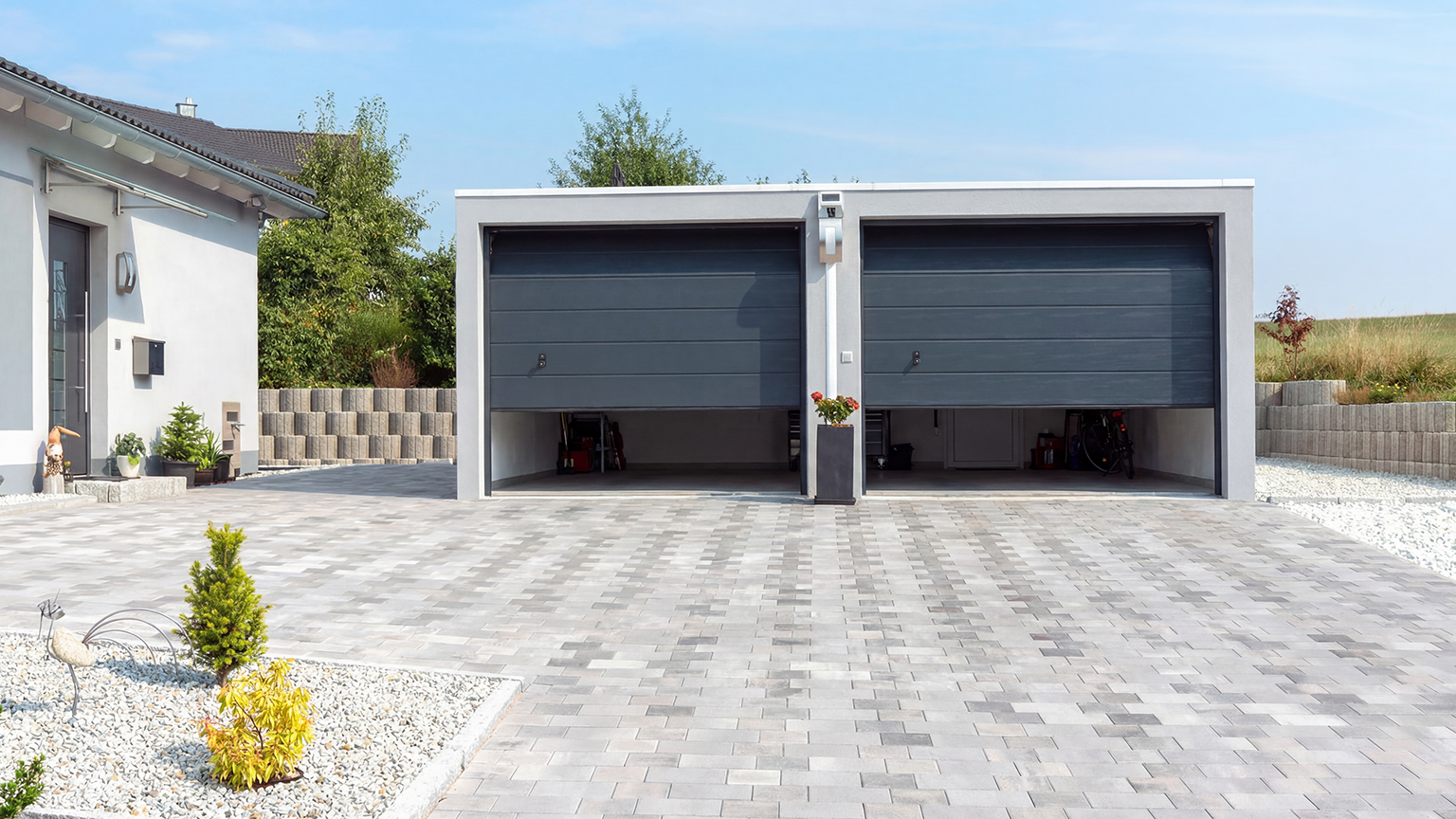
The width of the garage for cars is one of the most important factors when building a garage. The decisive factor here is, above all, how much available space is on the property. While 2.50 meters per parking space is considered the minimum, in practice this is rarely sufficient.
A realistic figure is 2.75 to 3.25 meters per vehicle, as this is the only way to ensure doors can be opened without difficulty. Especially with SUVs or wider vehicles, the space requirement increases significantly. The recommended garage width is therefore well above the minimum values and should—depending on the situation and available space—be adjusted to individual dimensions.
In narrow garages, parking quickly becomes a challenge. Additionally, the risk of scratches and damage increases. Generous planning therefore not only ensures greater comfort but also ensures that the garage can be used optimally in everyday life and offers additional space.
How do you correctly plan the width and height of a garage door?
Garage door dimensions directly affect the ease of entry and should always be tailored to the existing or available space. For single-car garages, the garage door width is usually around 2.25 to 2.50 meters wide and approximately 2.00 to 2.25 meters high.
A double garage door typically has a width of about 4.50 to 5.50 meters. This larger opening makes driving in much easier and provides more room to maneuver.
A distinction is also made between sectional doors and up-and-over doors. A sectional door requires less space in front of the garage and is particularly suitable when available space is limited. The up-and-over door, on the other hand, is generally more affordable but requires more space when opening.
Choosing the right door therefore depends heavily on the planned garage dimensions (car), the garage’s construction, and individual requirements.

Don’t miss out on any more information!
Don’t want to miss out on creative ideas for your garage? Whether it’s clever uses, new products, or exclusive promotions, our ZAPF newsletter will keep you one step ahead. Get regular inspiration delivered straight to your inbox and stay up to date on how versatile a ZAPF garage really can be. Simply sign up and become part of our community – it’s easy and, of course, free.
What are the dimensions of prefabricated garages made of concrete, steel, or wood?
The dimensions of prefabricated concrete garages are often predetermined, especially for standardized models. These fixed modules enable quick delivery and assembly and are designed to meet typical requirements, such as the space needed for a car.
Steel or wood garages, on the other hand, offer more flexibility and are often more affordable. Here, dimensions can be customized more individually, which is particularly advantageous when there are specific requirements regarding width or usage. The recommended garage width can also be better accommodated to ensure sufficient comfort in everyday life.
It is important to note the difference between interior and exterior dimensions. Wall thicknesses result in a loss of interior space, which is often underestimated during planning. Especially with prefabricated concrete garages, this difference can be crucial when it comes to making optimal use of the actual space available.
Why is the height of a double garage often underestimated?
The standard interior height of a garage is usually between 2.20 and 2.40 meters. This is sufficient for many cars, but it can quickly become cramped for SUVs or cars with roof racks—especially if the space for the car and garage wasn’t planned well.
A common mistake is assuming that the door height and interior height are the same. In reality, the door is often slightly lower, which leaves less space when pulling in.
Those who plan ahead should also consider future cars. A slightly taller garage offers more convenience and makes many things easier. However, cost is also a factor: Larger garages provide more space but are also more expensive to build and should therefore be carefully considered.
How do the dimensions affect the cost of a double garage?
The cost of a double garage depends heavily on its size. A larger double garage (length, width) requires more materials, higher transportation costs, and more complex installation.
Basic models often start at around 13,000 euros, while larger or custom-designed garages can quickly cost 20,000 to 25,000 euros or more. The cost of a double garage, its size, and price therefore increase directly with its dimensions.
Additional costs arise from the foundation, garage door, electrical work, or special features. That is why planning should always be comprehensive.
What are some common planning mistakes regarding the dimensions of a double garage?
Similar mistakes occur time and again when planning double garages. Many homeowners rely too heavily on minimum garage dimensions and cut corners in the wrong places.
A gate that is too narrow makes entering the garage considerably more difficult. At the same time, storage space is often overlooked, even though it is very important in everyday life. Failing to account for future vehicle sizes also leads to problems later on.
These mistakes can be avoided if the garage planning dimensions are carefully considered.
How do you properly plan a double garage—and what practical recommendations are there?
Good planning ensures that the double garage remains comfortable in the long term, as this is the only way to avoid future limitations. Therefore, a width of at least 6.50 meters is recommended, as this provides sufficient space for both vehicles and makes getting in and out much easier.
In addition, a generously sized garage door significantly improves usability by providing extra room to maneuver. At the same time, storage space should be factored in from the start—for example, for bicycles or tools—so that everything has its place and the garage stays organized.
It may also be helpful to compare carport vs. garage sizes, as an alternative solution might be worth considering depending on your needs. So, if you’re planning a double garage, you should consider all requirements early on to avoid having to make adjustments later.
Ultimately, a well-planned garage saves costs in the long run and also makes everyday life much more convenient.
FAQ (Frequently Asked Questions): Double Garage Dimensions
What is the minimum size a double garage should be?
The minimum garage dimensions are approximately 5.50 × 5.50 meters; however, this size is very tight and not very comfortable.
What are the standard garage dimensions?
Garage dimensions (standard for a double garage) are usually around 6 × 6 meters.
How wide should a double garage door be?
The width of a double garage door is usually between 4.50 and 5.50 meters.
How tall should a garage be?
The standard garage height is usually around 2.20 to 2.40 meters inside.
How much does a double garage cost depending on its size?
The cost of a double garage starts at around 13,000 euros and increases significantly depending on size and features.
What are the dimensions of precast concrete garages?
The dimensions of precast concrete garages are usually standardized and often measure about 3 × 6 meters for single garages. Double garages made of concrete typically measure approximately 6 × 6 meters. However, depending on the supplier, larger or customized versions are also available.
What garage dimensions are suitable for a car?
Garage dimensions for a car are generally around 3 × 6 meters. This size offers sufficient space for most vehicles and allows for comfortable entry and exit.
How wide should a garage be for a car?
The width of a garage per car should be at least 2.50 meters. For greater convenience, however, 2.75 to 3.25 meters is recommended so that doors can be opened without difficulty.
Sources
- ZAPF Blog Research Document – Internal document on keyword clusters and garage dimensions (as of 04/17/2026)
- DIN 18100 / Construction Practice – Guidelines for Vehicle and Parking Space Dimensions (unverified, as of April 17, 2026)
- Manufacturer Specifications (Prefabricated Garages) – Standard Market Dimensions and Garage Door Sizes (unverified, as of April 17, 2026)
Configure your garage in 3D now and experience it virtually on your own property!
With our garage configurator, you can easily and intuitively put together the size, features, doors, windows, and extras in just a few steps. We will then arrange a non-binding consultation appointment with you, on the basis of which you will receive an individual quote, naturally at a fair price and with no obligation to purchase. Experience your configured garage in impressive 3D visualization during the non-binding consultation appointment.